- thomasoneil.com
- Destinations
- Years
- Species
- Aircraft, etc.
- Methods Remote Trigger main page - 1 Bushnell trailcam - 2 Reconyx trailcam - 3 Moultrie trailcam - 4 Primos trailcam - 5 Browning trailcam - 6 Browning trailcam (melted) - 7 Reconyx trailcam - 8 Canon 5D Mark III remote trigger - 9 Canon 1D Mark II remote trigger -10 Canon M100 remote trigger -11 Browning trailcam (new) -12 Canon 6D Mark II -13 My brother's camera at his cabin -14 Gardepro close focus trail camera -15 Browning trail camera (new) -16 Drone (pro) -17 Drone (consumer) -18 Canon R5 Mark II -50 Seestar smart telescope Digiscope images Other remote triggers Celestial Events (solar filter)
- My other sites/blogs
| Plectranthus 'Velveteen Aromatic'™ | |||||
|
More than 30 years ago, my sister gave me a plant which she told me was Greek Oregano. Later when I did some research, it didn't look like the pictures I found of Greek Oregano, but I did find something called Cuban Oregano that seemed to be a match. But it is neither Cuban nor an Oregano. I also found a number of other mostly-inaccurate names for this plant including Indian borage, country borage, French thyme, Indian mint, Mexican mint, broad leaf thyme, soup mint, Spanish thyme, and Comfort Plant. I also found two Latin names, Plectranthus Amboinicus and Coleus Amboinicus. Even the Latin names are problematic as Amboinicus refers to Ambon Island in Indonesia, which is not where it is from. What we do know is the plant's native range is eastern Africa, the Arabian Peninsula and Southern Asia. It is part of the mint family. From what I can determine, the currently-accepted genus is Plectranthus, not Coleus. 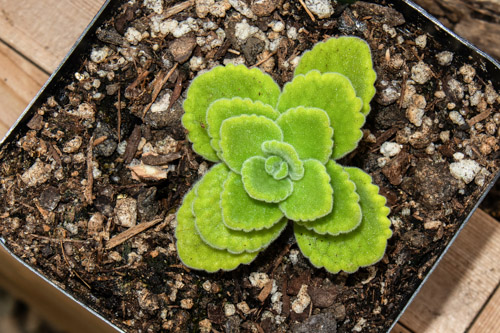
Plectranthus 'Velveteen Aromatic'™, two-month-old cutting Recently I have seen several examples of Plectranthus variations on sale at online retailers. Proven Winners is marketing what is says is a Plectranthus hybrid under the name 'Cerveza 'N Lime.' I'm guessing use of the Spanish word for beer is an homage to some of its inaccurate Mexican, Cuban and Spanish nicknames. Lime maybe refers to the color because it does not smell like lime. Mountain Crest Gardens and other online retailers are selling Plectranthus Tomentosa - Vicks Plant. It is called Vicks apparently because someone thinks it smells like Vicks VapoRub. The aroma of the plants I have is less intense and more pleasant than what I recall of VapoRub. Google AI says Plectranthus Amboinicus smells like oregano, with hints of thyme and tarragon. I'm not sophisticated enough to dissect that. I'll just say it has a distinctive aroma when you rub the thick, fuzzy leaves. There are culinary and medicinal uses, and supposedly it is a natural mosquito repellent if you rub it on. The Comfort Plant nickname seems to derive from these claimed capabilities, which I have not tried. Both of the commercial Plectranthus variations look just like the plant I have been propagating for more than 30 years. 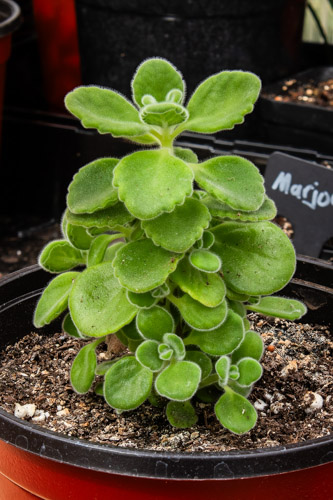
Plectranthus 'Velveteen Aromatic'™, about eight months old The plant is easily propagated from cuttings. I have used rooting hormone recently, but it is not necessary. It is either a succulent or a semi-succulent (whatever that means) with thick leaves, so lately I have been treating it as such and using coarse succulent potting soil. But before that it grew well in regular potting soil. I water it when the soil dries out, but has tolerated irregular watering over the years. In short, it is a very easy plant. But it is a tender perennial and can't be left outside during the winter unless you are in at least Zone 9. Supposedly it will flower, but in the decades I've been growing it (mostly indoors) it has not flowered. Because there is such confusion about what to call it, I have decided to add to the confusion and label the plants I propagate as Plectranthus 'Velveteen Aromatic'™. I think this is a much more descriptive name than the Proven Winners product. 'Velveteen' is for the fuzzy leaves, and 'Aromatic' is for the distinctive aroma. I am as certain as I can be that this is a Plectranthus, but because I'm not sure whether this is Amboinicus, Tomentosa, or something else, I'm dropping that part of the name. This is an unregistered trademark, which means that if you propagate this you should not resell it under that name without my permission. Its not worth it for me to sue you if you do, so if you do sell or give it away, please include this information with the plant. |
Top Menu | Destinations | Years | Species | Aircraft, etc. | Blog | Contact Info
All photos ©1998 - 2026 by Thomas O'Neil