Blog Posts
By Year
2026
2025
2024
2023
2022
2021
2020
2019
2018
2017
2016
2015
2014
2013
2012
2011
2010
2009
2008
2007
2006
2005
2004
2003
2002
2001
2000
1999
1998
| Succulents and focus bracketing | |
| I'm stocking up on succulents and using focus bracketing for their portraits. | |
| February 16, 2026 [Photos] | [Next Page - Fire] |
I acquired a greenhouse last July and kept it heated until November, but since then it has been left to the elements. All I can do is plan for the day when I turn the heat back on, which probably will be early April. I sketched out my plan for next year, ordered all the plants and seeds, and started to wait. 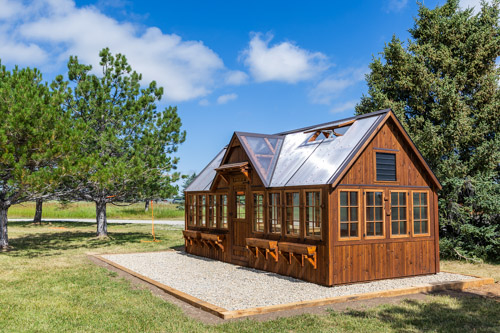
July 2025 The wait was driving me crazy, so I was thinking of ways I could get started on SOMETHING besides pots of mint and rosemary. The answer hit me: Succulents. I have had two plants forever, Aloe Vera and a plant which I misidentified for decades but which I now believe is a Cuban Oregano. I also have two other succulents recently received from relatives, a Thanksgiving Cactus and what might be a Tiger Tooth Aloe. For the most part, succulents are cool little plants and will not die if you neglect them for a few weeks or even months. I thought, "I should get a little Jade for an office plant." I got a little Jade, and a couple of other succulents. And some more, and some more, and some more. In less than a month, the count is up to 29 new succulents. They are all different except I got a second, bigger Jade. Succulents are slow-growing this time of year, so I'm taking pictures as I acquire them so I can tell later if they have grown. I have a high-end mirrorless camera and a dedicated macro lens, so taking pictures of these things should be a snap. But I was reminded very quickly that the ability to get very close just magnifies (so to speak) the problem of depth of field. If you take a macro picture of a round plant, a significant part of the image will be out of focus. The first thing you can do is use a smaller f-stop, which helps some. You also want to use a low ISO such as 100 to control image noise. With the smaller aperture and low ISO, you have to use a slow shutter speed, so you need a tripod. Even after all that, the depth of field often is insufficient. There is an automatic focus-bracketing function built into my camera. You set the initial focus at the front of the object, set the number of images to take and how much it changes focus between each image. Stack them all in Photoshop or some other application, and an image with great depth of field is produced. The image of this little Sempervivum Arachnoideum (which BTW might be dead) is 20 stacked images with a focus increment of 1. Camera settings were f/5.6, 0.8 second exposure, 100 ISO. 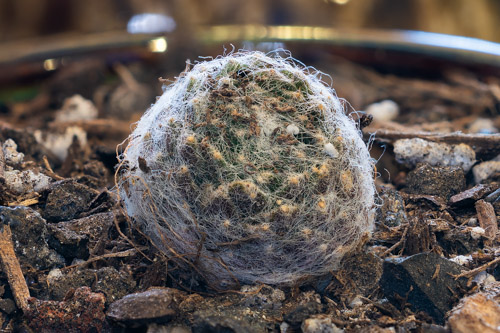 Planned focus bracketing, 20 stacked images It's also possible to combine images without using the camera's automatic function. This image is a stack of only two images which I did not intentionally bracket. But one had the center in focus, and the other had the outside rosettes in focus. They weren't framed exactly the same, so Photoshop automatically aligned them while stacking. There still is an out-of-focus zone between the middle and the sides, but stacking the two images allowed me to salvage the situation. 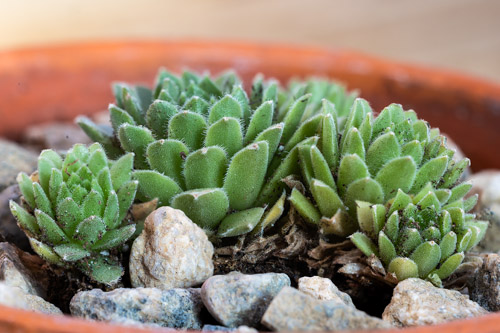 Impromptu focus bracketing, 2 stacked images On a side note, one good thing about the Sempervivums versus all the other plants I have acquired is they are cold hardy down to at least -20. The 10 different varieties are living in the greenhouse in February, which takes the pressure off me finding room for them in our house or heated (50 degrees) garage. The only exception is the little Arachnoideum shown above, which I think needs the warmth of my office to come back from the dead. It has not gotten below zero inside the greenhouse this winter, and has not been below 21 since I moved the plants there. I will do some more experimenting, but I think my next attempt will be fewer than 20 images (let's try 6) with a focus increment greater than 1 (such as 3) and an f/stop of 8, keeping the 100 ISO and setting the shutter speed as appropriate. The linked photo gallery includes most of the succulents I have acquired. I took most of them before I started focus bracketing. This first image shows that sometimes you want part of the subject to be soft. 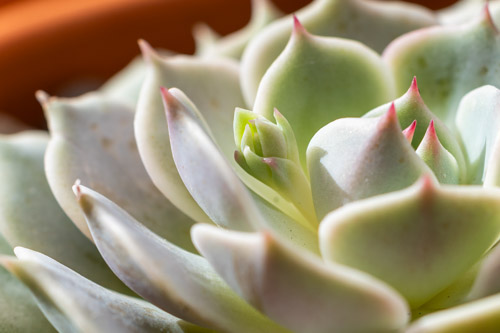 Echeveria Lola, only the little bud is in focus. I have added 34 images to the gallery so far. I haven't included any of my "legacy" plants yet - the aloes, Cuban Oregano, Thanksgiving Cactus. In a month, I might have 30 more plants to take pictures of (don't tell my spouse). I have added a page that includes all succulents and cacti that I have ever posted on this site, going back more than 20 years. It is located on the Home Page menu and other pages that have a menu at the top (like this one) under the Species tab, "All succulents and cacti." While looking through some of those old photos, I realized I didn't have any images of the classic Saguaro. I saw plenty of them 20-25 years ago on frequent trips to Arizona, so I looked through my archives and found three from 2002 to post in my Southwestern Landscapes gallery, including this one. 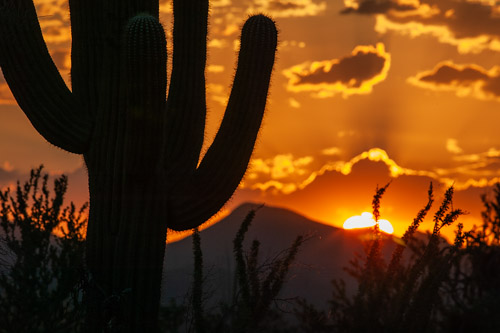 Somewhere in Arizona, 2002. Update 3/31/26: While doing focus bracketing/stacking with Photoshop, I noticed some problems with the way the program works. For a way-too-long discussion of focus stacking and my search for an alternative to Photoshop, see my two blog entries on Blogspot. Also, it is possible for Sempervivums to freeze to death, as 6 of the 10 proved during a cold snap just after this original post. But the good news is the little dry Arachnoideum ball did come to life in the warmth of our house, replacing one of the Semps that succumbed in the greenhouse.  It's a miracle! | |
Top Menu | Destinations | Years | Species | Aircraft, etc. | Blog | Contact Info
All photos ©1998-2026 by Thomas O'Neil